Pages

Friday, April 18, 2014

Good Friday Stations of the Cross

Listen here:


The name “Good Friday” really seems like a misnomer, the name doesn’t match what it is. Because on Good Friday we come together as a community to remember Jesus’ arrest, trial, crucifixion, suffering, death and burial. The purpose of Holy Week is to experience the story of Jesus; about putting ourselves in the place of his disciples, of the people in Jerusalem, the people who witnessed the end of his life. The Journey of Holy week is a journey of preparing ourselves for Easter, of remembering Jesus’ final days, of feeling the joy, the pain, the suffering, that knot in the pit of our stomachs, those things that we imagine those who were there might have felt.Notusually things we associate with the word “good”. But I’m here to tell you today that this is good news for us, that Good Friday is good because it makes Easter Sunday possible. That through Jesus’ death, God set in motion all that we would ever need for our sins to be forgiven and for our relationship with God to be restored. But we’re all aware that we still sin, that we’re still in need of God’s forgiveness so tonight we’re going to take our sin on a journey to the cross. Tonight I want to invite you to think of something in your life that’s separating you from God, because that’s what sin is, it’s something that separates us from God. That thing could be a habit or a behavior or an attitude that keeps distance between you and God, it could be a hurt or a fear or a distrust of God, it might be just plain not knowing what’s between you and God. You’ll find in your bulletin a piece of paper; we want you to take a moment to write down that thing that’s separating you from God right now. Write it down and fold it up, this is for you and God we’re not sharing these. I want you to hold that thing, that sin in your hand as we take this walk together tonight.
This walk we’re taking is traditionally called the stations of the cross of the via dolorosa which means “the painful way.” Christians throughout history have taken time to stop at these 14 stations to remember these parts of Jesus’ story, to give them a chance to feel what it might have been like, to prepare themselves for Easter. Tonight we’ll be projecting on the screen artistic representations of each of the stations, take your sin to each of these stations tonight, spend a moment reflection on the image and responding to Jesus.


(Please click on the individual pictures for source information)

Mount of Olives (Luke 22) When he reached the place, he said to them, “Pray that you may not come into the time of trial.” Then he withdrew from them about a stone’s throw, knelt down, and prayed, “Father, if you are willing, remove this cup from me; yet, not my will but yours be done.”"


Jesus betrayed by Judas (Luke 22): While he was still speaking, suddenly a crowd came, and the one called Judas, one of the twelve, was leading them. He approached Jesus to kiss him; but Jesus said to him, “Judas, is it with a kiss that you are betraying the Son of Man?”

Jesus is condemned by the Sanhedrin (Luke 22:66-71): All of them asked, “Are you, then, the Son of God?” He said to them, “You say that I am.” Then they said, “What further testimony do we need? We have heard it ourselves from his own lips!”


Peter denies Jesus (Luke 22:54-62): Then a servant-girl, seeing him in the firelight, stared at him and said, “This man also was with him.” But he denied it, saying, “Woman, I do not know him.” A little later someone else, on seeing him, said, “You also are one of them.” But Peter said, “Man, I am not!” Then about an hour later still another kept insisting, “Surely this man also was with him; for he is a Galilean.” But Peter said, “Man, I do not know what you are talking about!”

Jesus judged by Pilate (Luke 23:13-15): Then they all shouted out together, “Away with this fellow! Release Barabbas for us!” (This was a man who had been put in prison for an insurrection that had taken place in the city, and for murder.) Pilate, wanting to release Jesus, addressed them again; but they kept shouting, “Crucify, crucify him!” A third time he said to them, “Why, what evil has he done? I have found in him no ground for the sentence of death; I will therefore have him flogged and then release him.” But they kept urgently demanding with loud shouts that he should be crucified; and their voices prevailed. So Pilate gave his verdict that their demand should be granted.


Jesus crowned with thorns (Luke 22:63-65): And the soldiers wove a crown of thorns and put it on his head, and they dressed him in a purple robe. They kept coming up to him, saying, “Hail, King of the Jews!” and striking him on the face.


Jesus takes up the cross (Mark 15:20): After mocking him, they stripped him of the purple cloak and put his own clothes on him. Then they led him out to crucify him.


Simon of Cyrene helps Jesus (Luke 23:26): As they led him away, they seized a man, Simon of Cyrene, who was coming from the country, and they laid the cross on him, and made him carry it behind Jesus.


Jesus meets the women of Jerusalem (Luke 23: 27-31): A great number of the people followed him, and among them were women who were beating their breasts and wailing for him. But Jesus turned to them and said, “Daughters of Jerusalem, do not weep for me, but weep for yourselves and for your children. For the days are surely coming when they will say, ‘Blessed are the barren, and the wombs that never bore, and the breasts that never nursed.’ 

Jesus is crucified (Luke 23:33-4; 47): When they came to the place that is called The Skull, they crucified Jesus there with the criminals, one on his right and one on his left. Then Jesus said, “Father, forgive them; for they do not know what they are doing.” And they cast lots to divide his clothing.


Jesus promises his kingdom to the good thief (Luke 23:39-43): One of the criminals who were hanged there kept deriding him and saying, “Are you not the Messiah? Save yourself and us!”  But the other rebuked him, saying, “Do you not fear God, since you are under the same sentence of condemnation?  And we indeed have been condemned justly, for we are getting what we deserve for our deeds, but this man has done nothing wrong.”  Then he said, “Jesus, remember me when you come into your kingdom.”  He replied, “Truly I tell you, today you will be with me in Paradise.”
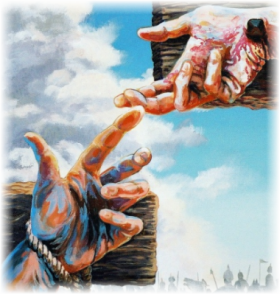
Jesus on the cross, his mother and his disciple (John 19:25-27): When Jesus saw his mother and the disciple whom he loved standing beside her, he said to his mother, “Woman, here is your son.”  Then he said to the disciple, “Here is your mother.” And from that hour the disciple took her into his own home.


Jesus dies on the cross (Luke 23:44-47): It was now about noon, and darkness came over the whole land until three in the afternoon,  while the sun’s light failed; and the curtain of the temple was torn in two.  Then Jesus, crying with a loud voice, said, “Father, into your hands I commend my spirit.” Having said this, he breathed his last.


Jesus in placed in the tomb (Luke 23:50-54, Mark 16:1-4): Now there was a good and righteous man named Joseph…He came from the Jewish town of Arimathea, and he was waiting expectantly for the kingdom of God.  This man went to Pilate and asked for the body of Jesus. Then he took it down, wrapped it in a linen cloth, and laid it in a rock-hewn tomb where no one had ever been laid. It was the day of Preparation, and the sabbath was beginning.


Friends, Jesus went on this journey for our sins, for that very sin that you wrote down, so that you don’t have to live with it anymore. During this time, you’re invited to come forward with that piece of paper and nail it to the cross, and leave it there. You’re welcome to spend some time at the kneelers if you’d like and I’ll be available over here to anoint you as you leave, but only if you want. In the United Methodist Church we believe that anointing is an act of invoking God’s healing love, it’s an act of asking for God’s love to make us whole: body, mind and spirit. This is an outward sign of a spiritual grace through Christ.

Pastor Jen

(c) Jen Hibben 2014

Sunday, March 30, 2014

Mary and Martha


Listen to the full sermon here:

Well I don't know about you, but I've had a very Martha-y week. I started the week with leftover to-dos from last week, a full schedule and as you can see, I'm preaching this week. And you all know what happens when you have that kind of week don't you? Meetings get changed, you realize you have meetings you forgot about, people come visit, people want to chat, nothing gets done, you kid doesn't sleep and somehow the sermon you typed up gets deleted, twice. Now I'm not complaining per se, let’s just say that it was a very to-do heavy week, and I wasn’t getting stuff done. By Friday I realized that I was embodying Martha in this story, I was distracted, anxious, pulled in a bunch of different directions. That’s not to say that the things I had to do weren’t important, that they were part of living out God’s call for my life, that they weren’t good things to be doing, they just got me all worked up. And let me tell you friends that it took me until Friday to finally hear Jesus' words. Friday! I've been working on this sermon since Monday at least! All the time I was trying to prepare this sermon, reading about these two sisters, one who was so busy and distracted, and I continued to let myself do what Martha did, to continue to let those to dos become really important things and then even drag me away from the most important things. Let me tell you I was literally near tears when I lost my sermon for the second time on Friday, but I also really got the sense that God was still trying to get my attention, very dramatically I might add and I didn’t exactly appreciate it. And let me tell you I can empathize with Martha today, because unfortunately I didn’t find away to let it go, I typed this sermon 3 times instead of taking a big step back and listening to what God was saying. So I’m up here today to talk to you about this from the position of someone who didn’t get it right this week. Who knows very well how Martha must have felt and who despite this week and despite my failures, still heard God speaking. 

Now I'm sure many of you are familiar with the story from the scripture today. So just a quick show of hands, there's no right answer here, if you had to choose, how many of you would say you're more of a Martha? How many would say you're more of a Mary? Like I said, no right answer here. Unfortunately I think the church has encouraged us to pick sides here, to value Mary over Martha, to take what Jesus said as universally applicable.  I was stuck in that rut this week, I think I made things worse by beating myself up for not being more Mary. That's a no-win and that's not what Jesus wants us to do, I don’t think that mentality empowers us to be true disciples.

So one of the things I do every time I preach is comb through the scripture in hopes of finding something interesting, so I think it’s of value for us to go back over what’s happening in the scripture lesson for today. Jesus and his disciples show up and Mary and Martha's place on their way to Jerusalem, obviously no phone ahead here, this was probably a little unexpected. And when they show up, the text says that Martha welcomed them into her home to them, other translations say that she opened her home to them or welcomed them as guests; she made them feel at home. She’s doing the hospitality thing, which was an extremely important part of this culture. So Martha is busying herself making these 13 people feel at home she was doing exactly what she was supposed to be doing and we can't forget that Jesus was her guest, he's basically the most important house guest ever. So she's doing what a host should do and at some point realizes she's doing it by herself, her sister isn't doing her share, in fact, Mary is sitting on the floor listening to Jesus. Now we need to take a brief pause to give Mary a high five because she took the position reserved for men during that time, for her to sit on the floor wasn't just making her sister mad, it was challenging the gender hierarchy of the time. Many scholars would argue that the important thing that Mary did was challenge the status quo for women and made more room for women at Jesus' feet. But that's lost on Martha, she is really upset that her sister has left all the work to her and that no one seems to care. Really, I think she’s jealous, she wishes she could be right there too, but she’s doing her darndest to take care of her guests. So while she was doing a great job as the hostess, she kind of loses her cool her and asks Jesus to intervene, not really a good hostess move. I can imagine that she’s been seething in the kitchen, cursing her sister under her breath until she can’t take it any more! She says to Jesus: "Lord, don't you care that my sister has left me to do all the work?" and if that wasn’t enough then she tries to tell Jesus what to do: "Tell her to help me!" Can you sense her frustration, her anger, the sense of injustice? I'm not sure I blame her really. But I'm guessing she wasn't anticipating Jesus' answer to her: "Martha, Martha, you are worried and distracted by many things; there is need of only one thing. Mary has chosen the better part, which will not be taken away from her." Jesus calls her out, he corrects her, he tells her she's wrong, probably not what she was looking for, not the justice she was hoping for. 

So often though we get to the end of the story and we conclude Mary is right, Martha is wrong, we should be like Mary, we should try not to be like Martha. But I'm not convinced that’s the point of the story. I don't think it's that black and white. I'm afraid that if we end with that conclusion we either feel smug because we're "right" like Mary or we feel like we're never good enough because we're like Martha. The truth is that if we praise Mary too much, she'll never get up off the floor and if we criticize Martha too much, she'll just quit serving; I don't think that's what God wants to say to us this morning. 

And I'll tell you why. One of the most interesting things I read this week about this passage is that we really shouldn't read it without connecting it to the story before it. Anyone know what story is right before this one? The story of the Good Samaritan. If you think back about that story Jesus is helping a young lawyer understand how to live the life that God wants us to live, and uses the story of the Good Samaritan. If we look back at that story, there is nothing about sitting at Jesus' feet. This is not a story about being contemplative. The words Jesus uses are action words, take care of him, go, do! So when we consider that these two stories are placed together, we can see that both of these are required for us, that Jesus says that the most important things are to love God and to love others, to spend time in devotion AND action. With Mary and Martha, we see Mary, loving God, and Martha, loving others; Mary in a time of devotion and Martha in a time of action. Now the problem here isn’t the fact that Martha is doing things, it’s the focus of her heart, she’s distracted and worried and pulled in too many directions. That’s why Jesus does say that one thing is needful, but he doesn't say that the one needful thing is sitting at his feet. He says that Mary has chosen the better part, not the only part, not the better thing, the better part. Jesus calls us to more than sitting on our rears. I wonder if what's needful is different at different parts of our day, different parts of our week, even different parts of our life. Ecclessiates 3 says: "For everything there is a season, and a time for every matter under heaven" A time for prayer and a time for serving, a time for meditating and a time for marching, a time for resting and a time for wearing ourselves out. Our lives are not so one dimensional that we can say clearly that there is only important thing, God didn't create us that way. So I think what the real question is this week, what God is asking us through this story is "what is the one needful thing in your life right now? Can you hear me calling you to get off your rear, or stop doing things and sit down with me?" Are you doing good things, but you’re distracted and worried? Are you spending lots of time with me, but failing to hear my call to DO something about it? There are times in our life when what is needful is sitting down with Jesus and there are times in our lives when we need to take action, we need to put into action the teachings of Jesus. 

You know this Sunday is UMW Sunday and when I chose this scripture for this Sunday, I was reminded of how the United Methodist Women's organization embodies this lesson. I'm not sure how familiar you are with the UMW organization, but one thing that they do is meet in circles, or small groups, where they study together, they share with each other, the eat together, the grow closer to each other and to God. But they don't just sit around in circles, that time in those circles empowers them to go out and take action. You might be familiar with the Annual Cookie Festival where they bake a ton of cookies and sell them to raise money for the mission and ministries of this church, and organizations in our community. They support and share the values and mission of the United Methodist Women organization as well, UMW promotes the empowerment of women, children and youth, anti-racism and multiculturalism,  inclusion and equity, fair labor practices, economic and environmental stewardship and sustainability. They’re not just sitting around, they take action to make our world look more like the kingdom of God, they fight for the needs of those less fortunate locally and around the world. They encourage all of us to think about what's needful in our lives, in our community and around the world, to spend time with God, to be connected to God's purposes and to do something about it. So today I encourage you to take some time, figure out where you might be right now, is the one needful thing right now for you sitting at Jesus’ feet? If so we have LifeGroups that are meeting to study both the Bible and other topics, we have a 24 hour prayer chapel that you can access from the parking lot, we have ways to help you be Mary. But maybe you’ve got that stuff down, maybe you’ve been spending lots of time just soaking up Jesus’ presence. That’s great, but what’s he telling you to do? We have plenty of ways that you can put into action your faith, by helping with things here at the church, by getting involved with mission projects here as easy as buying plants, and there are plenty of local organizations that would love for you to live out your faith in service. Today the good news is that God is calling us to do both these things, to love God and to love others, to worship God and to serve others. Amen. 

Thursday, March 6, 2014

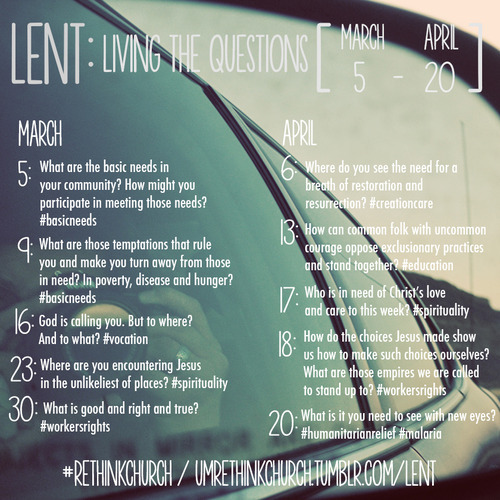
Rethink Lent: What Are the Needs of Our Community?


This year Rethink Church has put together this guide for Lent. There are so many things that we could do for Lent and this one is a great option for those social media lovers out there. I talked about some other thoughts in my Pathways article this month, and honestly hadn't planned on participating in this one this Lent. 

But on my home from our Ash Wednesday service last night I was shocked to realized that I remembered what the question was for this first week of Rethink church's guide. And as I pulled my baby out of his carseat, with ashes on his adorable little forehead I started to think about repentance. If you didn't or don't participate in Ash Wednesdays services, a concise summary might be: repent. That symbol of ashes on our foreheads, on my 1 year old's forehead, are a symbol of repentance. Throughout the Bible Jews and Christians alike have used the outward symbol of ashes to represent the inward repentance. Ash Wednesday is the start of the Lenten journey, the beginning of getting our hearts and minds ready for one of the most significant days in the Christian tradition. These thoughts aren't what I'd call "fully formed" so this is really up for discussion, but man, I really felt pulled to this today. 


Someone commented to me that they felt depressed after the service last night, that it wasn't uplifting. To which I replied that Ash Wednesday isn't really a "feel-good" service. But it's necessary.  I guess feeling crappy on Ash Wednesday is kind of necessary in way. 

So what is a basic need of our community? Repentance, I guess. But no, that doesn't quite feel right and I realize it's because the kind of repentance that God talks about has been hijacked. I started to wonder why there's a resistance to repent, why it's so hard for me to repent of some things. I can definitely repent for eating an extra cupcake, or even for being more sassy than I'd like to my husband. But what about these things we really NEED to repent for in order to move forward, for us to be closer to God on Easter than we were on Ash Wednesday? You know, like, manipulating others (and God) for your own purposes, or hoarding resources, or believing and acting like you know better than God or conspiring to do harm to any part of God's creation. You know, those bigger ones. The ones that would really rock our worlds and set us on a completely different Lenten journey than we've been on before. What's holding us back, when what we really need is repentance?

My guess is shame. I learned a few years ago that guilt needs forgiveness, but shame needs healing. guilt:forgiveness. shame:healing. No doubt that there is and should be some guilt that goes with repentance, that's how we know we need to repent, right. But does shame have to be a part of this? Can we liberate repentance from shame? I think that's key for me because I get the sense that the reason that we don't repent of the big things, the things we NEED to repent for, is because we'd feel ashamed. That by admitting that we need to repent of our selfishness/anger/fear/fill-in-the-blank means admitting that we don't have it all together, that we may have a character flaw or two and that maybe our actions and motives haven't been lining up with God's (despite what we've told ourselves). And with that goes not guilt, but shame. Shame that deep down we might terrible people, that deep down we're fakes, that deep down we wouldn't be loved or accepted. See how those things might need some healing, not just forgiveness?

But God calls us to repent to set us free, not to shame us. God calls us to repent because it's part of the journey toward wholeness and life to the fullest. God calls us to repent on Ash Wednesday because God loves us. The basic need is repentance free of shame, the basic need is a way to move towards God, the basic need is freedom from those big things that taint our lives. 

What's your big thing? Can you imagine what it would be like to repent for it? Can you imagine doing that without shame, without the judgments? Can you see the path forward without it in the way? Beautiful, huh? 

praying for peace and wholeness this Lent,

(c) Jen Hibben 2014

Sunday, February 9, 2014

Bright and Salty: A Bacon Sermon


Who loves bacon? It's very trendy to love bacon right now, most of you are probably aware of this because of things like BaconFest and the overabundance of bacon-studded options at grocery stores and restaurants. 


And do you know why bacon is so popular? Because it's delicious. Now I realize I might be alienating the vegetarians right now, but I'm not really sure what the bacon-equivalent is for vegetarians, so bear with me. Bacon is delicious, and so this week I was researching what it takes to make bacon. I'm one of those people that always wonders how I can make something that we're used to buying better or cheaper. So it turns out that bacon isn't that difficult to make. You start with a pork belly. A pork belly, the stomach of a pig. Now I know this is also trendy in foodie circles, but I am not going to eat pork belly by itself, that is not appealing to me at all. There are no redeeming qualities about pork belly except that it makes bacon. And do you know what makes pork belly bacon?  Salt. 4 cups of salt for about 4 pounds of pork belly. That’s a lot of salt. But you know what? Salt makes things taste better. Salt makes things better.
          Our scripture for the day is the end of Jesus’ Sermon on the Mount, which sometimes we call it the beatitudes.  A few months ago we talked about this because the first part of this sermon talks about those who are blessed and Jesus says over and over, blessed are… so Jesus has just finished turning our idea of what being blessed means upside down and then goes on to this bit about salt and light that we read today.  
We probably don’t think too much about the importance of salt in our day to day lives, but in Jesus’ time, salt was essential. It wasn’t just a seasoning, it was used as a purifier, a disinfectant, a preservative, part of religious sacrifices, and even a symbol of friendship. We now know that salt is absolutely essential for the human body to function, even on the cellular level. Now they may not have known that at the time that Jesus was giving this sermon, but they did know that salt was really important. Just like with bacon, salt makes things better; in Jesus’ time it purified things, it disinfected things, it preserved things. Obviously this is symbolic so I like the way that the Message puts it: “You’re here to besalt-seasoning that brings out the God-flavors of this earth.” The God-flavors, the good, the pure, the clean, the righteous, the peaceful, the hopeful, the redemptive flavors of the world. We are here to make things taste better; to make things around us better.
Now Jesus also says we are the light of the world. And some of the same can be said for light. Light was also essential in Jesus’ time as well. When it was night in Jesus’ time, it was DARK, really dark. Can’t see your hand in front of your face dark. Light was necessary for people to be able to function after sundown. It also had strong religious connotations. What was the first thing that God created in Genesis? Light, God created the light first. Light is always connected symbolically to God, representing goodness and truth and hope. The message has a good way of saying this too: “You’re here to be light, bringing out the God-colors in the world.The God colors, illuminating the work that God is doing in and through and among us. Highlighting the good news that God is alive and active in our world.
Now I really like the Message’s paraphrase of these verses, because I think it awakens our imagination to what it means to be salt and light in the world. We’re supposed to be salt: making things better, and light: highlighting God’s work here. But there’s a problem with this translation, with the way this is paraphrased, and I think I’ve made the same mistake every time I’ve read these verses too. The Message says: “Let me tell you why you are here. You’re here to be salt-seasoning that brings out the God-flavors of this earth… Here’s another way to put it: You’re here to be light, bringing out the God-colors in the world. I always got the sense that this was a command, Jesus saying, “hey, you’re supposed to be salt and light!” You should be doing this, you should be doing that. But when I took a look at some of the other translations, and did some more research, I found out that this isn’t a command. The way that Matthew wrote this has no hints of command, this is actually a blessing, Jesus is giving those who heard him, and us today, a blessing.
Have you ever heard the term “self-fulfilling prophecy”? The idea is that if you tell a child, or an adult for that matter, that he or she is good or bad or naughty or smart or any number of things, regardless of whether that label is true, if we hear it enough, we live into it. We become what we’re called. We become what we’re called, whether it’s true to begin with or not. And that’s what Jesus is doing here with us. He’s not saying, you better be salt and light, or you’re supposed to be salt and light, or “good Jews” or “good Christians” are salt and light. He says YOU ARE the salt of the earth, YOU ARE the light of the world. You already are, it is a part of who you are so live it out, don’t be shy! Friends, this isn’t a command, Jesus is not giving us directions, he’s giving us a blessing, an affirmation, he is commissioning us to live into our identities as Christians, to make the world a better, brighter place. The good news is that this is not another expectation or list of rules, this is confirmation that we already have what we need, that it’s a part of who we are, it’s built into our DNA we just have to live it out.
Now I hear some of you saying, to yourself of course “but Jen, you don’t know me, the ways that I’ve hurt people, the ways I’ve hurt myself, the messes I’ve gotten into. I’m not really good, I’m not the salt and light Jesus is talking about. Best case scenario, I just keep myself out of trouble.” Point taken, I think the things that we do and that are done to us work against the truth that we are good. But do you think Jesus thought he was talking to a bunch of saints? Do you think God doesn’t know what you’ve gone through and what you’ve done? God knows us better than we know ourselves, Jesus wasn’t fooled by pretenses or big shows of piety, Jesus came for the outcast, the marginalized, the downtrodden, those who are not perfect. And still he says, “You ARE the salt of the earth, you ARE the light of the world, now live like it!”
But this salt and light bit isn’t the end of our scripture today either, and I think now that we understand this first part, maybe in a new way, now that we know that this is an affirmation not a command, we can read this second part in a new light as well. This is the part where Jesus is saying that he did not come to abolish the law, but to fulfill it. Part of this is a reaction to those who were saying that Jesus wasn’t respecting or following the law, and teaching others not to follow it either. And while I’d be one of the first people to claim that Jesus was not into legalism and rule-following as the key to the kingdom of God, he’s very clear that he’s not opposed to it and he’s not here to make it go away. He came so that we would understand the law better, that we might see what the law looks like when it’s not distorted by legalism and competition and one-upmanship.  Just like Jesus reinterpreted our understanding of being blessed in the first part of this sermon, just like Jesus helps us reinterpret how we understand ourselves as salt and light, Jesus helps us reinterpret the law. God didn’t create laws that were flawed and God didn’t create the laws so that people could be legalistic about it. God gave the law to the people of that time to help them know what it would be like to live in the kingdom of God. God gave the law to God’s people so they would have some guidelines, some sense of how God would want things to be. Like with most things though, we’ve gone and messed up the original intent with our sin. Jesus came not to abolish the law, not to declare it null and void, but to fulfill it, to reclaim it.
          And I couldn’t help struggle a little bit with putting these two parts of scripture together at first. Jesus is giving this blessing and affirmation and then seems to throw in this “And hey, don’t let people say I’m trying to mess with the law because I’m not, don’t forget the law!” It seems kind of defensive to me at first. But as I began to think about some of the questions we have, some of those voices that come into play when we hear Jesus of all people telling us that we already are salt and light, that making things better and shining light on God’s work is a part of who we, I realize that maybe Jesus isn’t leaving us hanging. That like God, Jesus offers us some more guidance a clue to figuring out how to be more salty and bright. While we might doubt Jesus’ blessing and affirmation to us, while we might want to leave salt and light as nice symbols that don’t require much of us, Jesus’ clue to us is to look to the law. If you’re not sure what being salt and light looks like, look to the law. Not the law that the Pharisees and concocted or interpreted, but the real laws that God has given us, the keys to the kingdom of God. If you’re wondering what it really means to bring out the God-flavors and the God-colors in the world, look to the law, but look at it through my eyes. And we know how Jesus understood the law, we find later on in Matthew chapter 22 where a Pharisee, a so-called expert in the law, asks him which is the greatest commandment. And do you know what he says? He says: “You shall love the Lord your God with all your heart, and with all your soul, and with all your mind.’ 38 This is the greatest and first commandment. 39 And a second is like it: ‘You shall love your neighbor as yourself.’ 40 On these two commandments hang all the law and the prophets.” On these two commandments hang all the law and the prophets. The law is summed up this way: love God and love others. You are salt and light when you love God and love others. It is a part of who you are, it’s in your DNA. You are salt and light, and you know what salt and light do? Love, love God and love others.
No matter what drama we’re going through, no matter the challenges we have, we here at West Des Moines UMC are the salt of the earth and the light of the world. We do make the world a better place and we do shine light on the ways that God is working in the world; we do love God and we love others. Just last week we had the Costa Rica Mission team leading us in worship, reflecting on ways that they worked with God to make the world a better place and the places where they saw God working for good in the world. If you remember at Christmas time, LifeTree Café attendees had the opportunity to make stars out of dollar bills, with the intent to give them to someone who was working on Christmas. And on Christmas day, Paul Gesell was at Caseys a gave one of those stars to a woman who was working. She was so appreciative; she hunted down our facebook page to thanks us. We have the prayer shawl ministry LifeGroup, that makes hospital and hospice rooms a little brighter with the reminder that person is loved and cared for. The money that we all collectively gave to Habitat for Humanity both here and in El Salvador so that other lives and communities might be better. The people who cook meals here every Wednesday so that we can come together and share a meal as a community so that we can shine a light of the ways God is working around us. There are so many more examples, I know that each of you could name one. All of you who give of your time and money and talents so that this faith community can make the world a better place and so we can continue to point out and shine a light on the fact that God is alive and that God is at work in and through and among us. All of you who love God and love others, we are already the salt of the earth, we are already the light of the world. Our call now is to live that out more deeply, more passionately, more tangibly wherever we are and where ever we go. Amen.

You are the salt of the earth; You are the light of the world. Let your light shine before others, so that they may see your good works and give glory to your Father in heaven. Go into the world now and be salt and light, be the church. Amen. 

(c) Pastor Jen Hibben 

Sunday, February 2, 2014

Costa Rica Team Sunday

This Sunday we had the pleasure of the Costa Rica Mission Team leading us in worship. In early January a team of 12 representatives from our church went to visit and work with Strong Missions in Costa Rica. In 2012, this congregation raise over $10,000 to support the feeding programs of Strong Missions. Strong Missions is connected to the United Methodist Church through its Volunteer in Mission program (VIM). You can learn more about this trip and how you can help in the future by attending or hosting a presentation with your group or organization. Please contact Robert Bayse to schedule a presentation. 


The following was written and preached by members of the Costa Rica Mission Team on February 2, 2014.


Mike
          Today’s scripture from One Peter is a message directed to the Christian churches located in an area under the rule of the Roman Empire in the latter half of the first century AD. Christians of that era were counter cultural; they went against what society expected or demanded of them.  Because they were different, Christians were treated with scorn and subjected to verbal and physical abuse by others.  Government officials also began to view Christians as potential threats to civil order and initiated a campaign to harass and persecute them in a severe fashion.  To say the least, just as Christ had encountered before them, suffering was a normal part of the experience of being a Christian for those to whom this letter was written. 
          This morning we are going to draw from this lesson in the Bible.  We are going to relate a powerful story that we learned on our mission trip to Costa Rica and we are going to hear of the personal challenges that have been met by one of our mission team members.  From each of these different sources you will see how by doing good for others and by improving God’s Kingdom here on earth, we not only can bring comfort to those whom we are helping but at the same time help ourselves overcome suffering that we may be experiencing in our own lives.

Joy
          We all experience some kind of suffering whether the loss of a friend or family member, our own illness, broken relationships or even what just feels like bad luck.  During our mission trip, we learned of the story of Pastor Humberto who is no exception to that rule.  As a young man in his twenties, Humberto was working with members of his congregation cutting trees in the forest to provide wood for the construction of houses for those in need of shelter.  While doing this work, one of the trees that they were cutting fell in the wrong direction and landed directly on Pastor Humberto.  He was pinned underneath the tree and lay there in agony for three hours before his fellow workers could get access to a pickup truck to pull the tree off him.  Once loaded onto the back of the truck, they transported Humberto many miles across rugged terrain on bumpy, barely passable roads to the nearest hospital.  A full ten tortuous hours following the tree falling on him, Humberto was finally taken into surgery and the doctors discovered that he would be paralyzed from the waist down.
          Unfortunately, the suffering did not stop with the surgery or the loss of his mobility.  While in recovery he continued to be wracked with severe pain but his nurses refused to provide him with pain medication.  They taunted him saying, “You are a man of God.  If you are in pain, pray to your God to make it stop.”  Permanently paralyzed, far from home with no friends or family to comfort him, plagued by excruciating pain and tormented by those who were supposed to help him, Humberto called out for God to take his life. And God answered his call in a way Humberto did not expect.
Caltin
          I am no stranger to suffering, as I’m sure each of you could say as well.  While I don’t wish to equate my suffering to that of the Christians of Peter’s time or Humberto, it is important to recognize that we all suffer and we are all under the same call to endure our suffering and respond to it in Christ like ways.  During our trip, we had nightly devotions and one evening we were asked to say something we admired about the person to our right.  When my moment in the spotlight came, Mike began with, “Caltin, your quiet demeanor…” which led to hearty laughs.  I am certainly not known for being quiet and timid.  I always wear a smile and a laugh and I do that proudly which makes it no small task to stand up here and tell my story of suffering.  I would much rather remain the Caltin you all know and love or at least think is adorably funny.  However, if telling my story can help even one person get through some hardship, I gladly bare my soul today.  The last year and a half have been very bumpy for me.  My biggest struggle lies in being unemployed for so long and thus being without insurance.  I have diabetes and shortly before I lost my job at Wells Fargo, was diagnosed with the onset of depression.  With medication, I was able to manage both diseases with success but when the job ran out, the insurance ran out, the meds ran out, and I was given a trial that would test my faith and strength more than anything had before.  At first I was able to self-regulate my diabetes and my depression…well, in truth, I just ‘acted’ my way around them for months.  Really, I should be given an Oscar for my performance.  A few months ago however, I hit my breaking point.  Rather I should say my body hit its breaking point.  I was still on stage but behind the curtain I was constantly fighting thoughts of worthlessness, emptiness, that I had been forgotten by God and anyone who loved me, and worst of all I just wanted to stop existing. I really tried to back out of the trip to Costa Rica.  The health problems were running my life and the financial desert I was in made it seem impossible to be a part of this mission trip I had been so enthusiastic about.  God was not part of my struggle at this point.  I was under the impression that I could handle it on my own.  When that didn’t work, I sunk so low I was sure there was only one way to fix all my problems.
Mike
          But the Bible, God’s message, always offers us good news and hope.
          In today’s passage Peter tells the early Christians to humble themselves under God’s hand, that is, to become instruments for improving God’s kingdom here on earth.  By trusting in God, they could cast all their cares and worries to God…not one or two…ALL of their worries.  Why? Because God cares about His people.  God loves us.  When we become servants of God’s will and help others who are troubled or in need, we lighten our own suffering by thinking less about ourselves and more about others.
Peter warned the early Christians about forces that would threaten their faith in God and that would “devour them.”  Peter saw that when people are suffering and undergoing hardship they are vulnerable to questioning their faith and being led away from God.  He urged the people to trust in God, to place themselves under God’s protection by “humbling themselves under God’s mighty hand”.  Peter further noted that whatever suffering that the people were called upon to endure during their time on earth paled in comparison to the everlasting time thereafter where we will be completely restored and renewed in the image of God. 
          Peter realized that people can draw strength from being part of a community and he pointed out that the followers of Christ were part of a much larger family of believers around the world who were facing similar challenges.  Being part of a larger group of people with a common set of problems allowed the early Christians to help each other as they knew very well the suffering that each was undergoing. 
The lessons apply to us today as well.  We must avoid the temptation to blame God and lose our faith when misfortune occurs.  When bad things happen to us, that is the time to be even more resolute in seeking to serve God.  We can do this by reaching out and extending a helping hand to our brothers and sisters in need—no matter where they live.  By keeping our focus on the needs of others rather than our own difficulties, we can cast off the stresses that torment us and enjoy the comfort of God’s Peace.
Joy
          There is good news in Pastor Humberto’s story as well.
          Overcome by his hopelessness and suffering, Humberto prayed to God to let him die so that his pain would cease.  This went on for days and one morning, a person whom Humberto had never seen before came into his room and told Humberto that he had been sent by God.  Humberto asked the man, “Why? Why did God let me survive this when I am crippled and in so much pain?”  The stranger answered, “No por que, para que?”  Which means “Not why, for what?”
          The stranger then slipped out of the room and was never to be seen again.  When Humberto asked the doctors and nurses if they had seen a man come into his room, no one had.   Humberto then knew that God saved his life for a reason and from that point forward he would place his complete faith in God’s hands.  When the nurses finally approached him with pain medication, Humberto refused saying that God had taken away his pain.  That was 14 years ago and now Humberto is a pastor in one of the slums we visited which is home to thousands of refugees and is marked by extreme poverty and gang violence.  But, Humberto is there, in his wheelchair, pain-free and positively effecting change in his community, making it look more like the Kingdom of God.  Humberto told us that as soon as he turned his attention to figuring out what God wanted him to do, he thought less of himself and his circumstances and more about how he could help others.
Caltin
          Through several chats with Pastor Jen, she helped me hear God’s words urging me to trust God and God will provide a way for me to go on the trip and to get me through whatever I was going through…I was able to join the Costa Rica mission team by heeding God’s words of wisdom.  My struggles were far from over though.  As the date of departure to Costa Rica neared, I became more and more filled with anxiety.  How would I deal with the constant thirst and other symptoms of completely out of control diabetes in a third world country where the water may not be safe to drink?  My biggest worry was that this suffocating depressing darkness I was in would prevent me from participating and helping.  I knew I was too unstable to be going out of the country but Jen said trust God so that’s what I did.  From the moment I woke up the morning we left until the moment I returned to my home I experienced the most peaceful calm and relief I have ever experienced in my life.  The entire time I was in Costa Rica I did not have one symptom of diabetes or depression.  I could feel my sugars level out and was granted the freedom to focus on doing God’s work and recognizing God’s purposes in sending me to Costa Rica.  Being free from depression and demands of diabetes enabled me to put others before myself and provided the opportunity to do as much good as I could fit into 8 days.  My chains were gone and I was set free.
My struggles are still far from over, but this experience has given me several things to consider.  Back here in the states my suffering seems just a bit more bearable, I know without a shadow of a doubt that God’s promises are no joke…when God says trust in me and do good and I will take your suffering from you….God will make good on that promise, and lastly that we are all connected in so many ways but most apparent to me, through our suffering in Christ.
          Each of us will encounter problems in our lives and some of those problems may be quite severe.  Some of us may be going through some pretty tough times right now.  What Peter reminds us is that we don’t have to be in these struggles alone.  God is available to help us if we are willing to let that happen.  No matter what we are going through, we cannot let our problems define who we are.  Our trip to Costa Rica illustrated that responding through hardship by doing good can provide us with two paths to choose from in order to heal.  As in Humberto’s case, doing good can give us a purpose to our suffering and in my case doing good for those in need can help get us through our suffering by focusing on other things.  And let’s not forget that by choosing his path, Pastor Humberto’s life and the lives of countless others are better by incalculable degrees. 
          Our prayer for us all is that we start today to let Pastor Humberto be our example and inspiration by repeating and living the mantra “No por que, para que?”  “Not why, for what?” 
Amen.


Sunday, December 15, 2013

When the King Comes, God is with Us


Good morning. So 10 days until Christmas! Who’s excited? I know that realization might inspire a variety of reactions this morning. I'm going to guess that for all of the kids that is awesome news. I'm going to guess for some of the rest of you it’s a mix of excitement and anticipation, seeing friends and family, celebrating traditions; and dread. Maybe it's because like me, you still have presents to get, or because this is the first Christmas without a loved one, or because you're not sure what Christmas will look like this year, or because you know what Christmas will look like this year and it's not good. I think that mix of emotions, that mix of reactions is a pretty good representation of what Advent is like. Excited anticipation mixed with a little worry, fear and uncertainty.
Today we're continuing this sermon series on what happens when the king comes. We've talked about when the king come there's light and peace and today we're going to talk about how when the king comes, God is with us, Immanuel. We've been reading from Isaiah these past weeks, and as we know Isaiah was a prophet who was telling God's people what God had to say. We've talked about what Isaiah said about the king that was to come and the vision of how things would be when the king came. And today's text talks about a sign that will show that the king is coming. 
This week understanding the background of what was going on with the characters in the text is really important. We’ve talked about the not-so-good situation that the Israelites were in, but Isaiah's prophecy about this king to come happens while there is a war threatening the kingdom of Judah. The king at that time was King Ahaz, and he is trying to figure out what he should do to save his kingdom. They are not a military powerhouse, they don't have strong allies, they don’t have favors to call in, the odds are against them and Ahaz is worried that they're going to be completely wiped out if they don't get this right. He's getting pressure to join alliances, but he realizes that he and his country will basically be a pawn. There really isn't a clear solution, just a sense of impending doom. So in today's text King Ahaz talking to Isaiah and Isaiah tells him not to worry or fear, easier said than done right? So then Isaiah tells him that he's supposed to ask God for a sign. Now Ahaz tells Isaiah that he doesn't want to test God, honestly it probably seems like a trap since testing God was not something that you were supposed to do. But Ahaz isn't really that pious, he's actually scared of what God might tell him or what the sign might be. I imagine that his situation must have been so overwhelming that he was pretty much paralyzed by fear and uncertainty. There didn't seem to be any good way out of the situation so asking God for a sign might just be more than he could handle at that point. So Isaiah figures this out and tells him "fine, you won't ask God for a sign? God's going to give you a sign anyway, whether you like it or not." And here's the sign: a young woman will have a baby and name him Immanuel and this child will be the sign that things will get better for the Israelites. Probably not what Ahaz was expecting, and you know what, it doesn't really help his situation at that point!
I wonder what we do and what we should do when we're faced with overwhelming situations in our lives. I've thought a lot this week about what we do when things aren't going well in our lives. This past week we've experienced an unexpected death in our congregation, mourned the death of Nelson Mandela, suffered another school shooting while remembered the anniversary of the Newtown shootings, and all that on top of the anticipation, excitement, stress and anxiety of the holidays and everything else going on in our lives. I don't know what else you have going on in your life, but this can be a pretty overwhelming time.  
I imagine that's a little bit what like King Ahaz felt, just plain overwhelmed, so weighed down by the circumstances in our lives that we can't imagine what to do next. One morning this week I was watching the news and I saw a segment about the Newtown shootings and they had the father of one of the little girls who was killed write a letter to himself. 

 I imagine that none of us would know how we could make it through such a tragedy, until we have to go through it. I can only imagine that it's probably the most overwhelming thing in a person’s life, and I imagine that we would all be asking some of these same questions.
Sometimes these situations, whether they are a death, a betrayal, abuse or tragedy, are so overwhelming that we are scared to ask God for a sign too, too scared to ask God those questions that we have. We worry that we might be scared and even more overwhelmed by the way God might respond. I tried to list this week all the bad things that can happen in our lives for which we wish we could ask God for a sign or an answer. Everything from disappointment to illness to abuse to war. There's a lot of times where we just want to ask why? Why God? Why would you let this happen? How are we going to make it through this? How we will survive? And as I thought about all those things that happen in our lives, as I thought about all of questions we have for God, all of the times we wish that God would just explain to us what the heck is going on, I began to think more and more about God's sign, God's answer to Ahaz's overwhelming predicament. 
God's sign to Ahaz is a little confusing, a little vague and it probably didn't make immediate sense. How is this baby who's not even born yet going to solve the very real immediate problem that Judah was going through? God doesn't give Ahaz a secret weapon to defeat those who were threatening them. God didn't take away the threat or the tumultuous situation, no David and Goliath this time. God didn't even explain to him how it was all going to work out in the end. God said, I'm giving you Immanuel; I will be with you. The answer to all your questions, the fix for all this is my presence. 
Now we jump ahead to Matthew and see that he interprets this text to make a connection to Jesus. Matthew wrote his gospel specifically to Jews, so they would have been familiar with this text from Isaiah and been able to make this connection too. The writer believed and we do too, that we can better understand Isaiah because we now know who he was talking about and we can see how Jesus fulfilled his prophecy. Now you'll notice Mary didn't name her baby Immanuel, but that doesn’t negate Isaiah’s prophecy, the name Immanuel has a deeper, more profound meaning, especially when we connect it to Jesus. It isn't his given name, or the name he was called or went by, but it is who he is. Because Immanuel, whether you spell it with an I or an E, means God with us. We believe that in the truest sense that Jesus was and is God with us, Immanuel. Now we don't know for sure if Ahaz "got it" or if any of this made sense for him, but God's sign to him is a sign to us too.
I wouldn't doubt that sometimes we wonder, especially during Advent, how this baby who's not even born yet going to solve our very real and immediate problems? How the heck is Jesus going to solve my problems? And the truth, much like in Ahaz's case, is that God is not necessarily going to solve your problems. The answer to your problems is not always going to be clean-cut and easy to swallow. The more funerals I do, the more tragedy and injustice that I witness, the more convinced I am, that I will never have the answers, I will never be able to give families an explanation of why their loved one died, and any attempt at that will never be satisfying. I won't be able to explain why injustice and evil and poverty are allowed to exist and I know now if I try it will never be true or satisfying. I know that we want answers, I know we want to be able to explain and fully understand why life is the way it is, but we can't. We want to be able to navigate the ups and downs and questions and heartaches of life, but the more we try, I think the more unsatisfied we are. God knows that. I think that God knows and God gives us the same answer he gave King Ahaz: Immanuel, God is with us. While all of our attempts at answering the tough questions of life aren't satisfying, God's presence is. While we crave understanding and explanation, a little deeper is the desire to just feel God's presence. God's presence doesn't necessarily solve the problem or take away the hurt or pain or grief, but it somehow satisfies. It brings that peace that passes understanding that we talked about last week, and somehow it's enough.
So what is the thing right now in your life? What are you looking for a sign for? What question have you been trying to answer? And what if God's answer is just Immanuel? That God is with you? My prayer for you all this week is that whether you're going through something right now or not, you will in the future, that through all the questions and doubts that God's presence will be the overwhelming answer, that even though it won't make sense, that God's presence will be enough, will be satisfying your longing. And isn’t that what Advent’s about, isn’t that what we’re waiting for? When the king comes, God is with us. God's response to the way this world is, the pain and heartache and sin is simply God's presence. No quick fixes, no once and for all miracles, no detailed plans for fixing it all, but Immanuel, God with us. Amen. 

Pastor Jen Hibben 


Sunday, December 8, 2013

When the King Comes, There is Peace


So welcome to the second week of Advent. Today you saw that we lit the candle of peace; last week's candle represented hope and this week we focus on thepeace that Christ brings. You know the journey of Advent is meant to be a time for us to anticipate and to wait for the coming of Jesus, to anticipate the changes that he made and continues to make in our lives and in the world. This waiting, of course, is not unique to us. We see in the reading from Isaiah today that the Israelites were waiting too, waiting for a kingdom that was better than the one that they had, waiting for a king that was better and greater than any king they had before. Our waiting in Advent helps connect us to the waiting of the Israelites, the waiting for the Messiah, the waiting for the kingdom of God. Last week Dr. Daniel talked about how when the king comes there is light. He gave us an idea of how life would be different for us when we live in the light of God that’s ushered in by Jesus. We can imagine what it's like to live in darkness, some of us probably know what it feels like, and some of us probably feel like we're living in darkness right now. So we can imagine the need, the deep desire to live in the light, to have the light of God illuminating our lives. 

And today I want to talk about peace; about how the Israelites waited for a king to come, a king who would bring peace and wonder about how we too are waiting for peace in our own lives...

You know we're fortunate to live in a country and a time that is not characterized by war, or foreign occupation, political, social or religiousoppression. Truthfully those things exist here and some experience them more so than others, but we cannot deny that we enjoy lives of comfort and freedom and relative peace especially compared with our brothers and sisters around the world. The people of Israel were not so fortunate in the time of the prophet Isaiah.Although they were God's chosen people they had experienced war, oppression, maltreatment and discrimination and exile. Their situation was pretty bad and they were desperate for change, but they were stuck waiting. And as we see in the scripture for today, Isaiah gives them a vision of what things will be like when change comes, when the King comes. He describes a king that is better than they can imagine. They thought that King David was awesome, but this king is going to be way better than that, the perfect king. And at this point the Israelites are pretty desperate for a good king, a king that will restore them to glory, or at the least justmake things better. I imagine that when Isaiah describes this king, the Israelites areon the edge of their seats with desperationalmost salivating, if you can salivateover something that you're not going to eat. This king Isaiah describes is wise and understanding, strong, righteous, filled with the spirit, fears the Lord, judges with equity and a preference for the poor and oppressed and that destroys evil. Just what they need. But what Isaiah says in the reading for today is that this great kingdoesn't come alone, the king brings with him a kingdom, a kingdom of peace. Where the wolf and the lamb, the calf and the lion and the fatling, the leopard and the kid, babies and dangerous snakes all co-exist without the fear; /where natural enemies rest and play together. /The king does not just bring himself, he brings a kingdom of peace. 

Obviously in Isaiah's time the Israelites didn't know about Jesus per se, they didn't know who this king would be. We as Christians can look back at this scripture and say that there is a clear connection to Jesus and that Jesus is in fact this king and does in fact bring the kingdom of God to earth and with that, peace. Now we talked a few weeks ago about the fact that the kingdom of God is alreadyhere, but not fully here yet, that we still have a ways to go to make the whole world look like the kingdom of God. So much like the Israelites, I wonder what peace looks like for us. Like the stereotypical Miss Americas of the world, we can hope and pray and dream about world peace, but what does that look like? What would it mean for there to be real peace and how does Jesus bring that to our lives? 

I think one way is that the king brings peace to our hearts. I’m convinced that we have to experience God's peace in our own lives in order to understand better what peace really is. Jesus talks about a peace that passes understanding, and I think that if you've experienced God's peace, you know what that means, but you probably can’t describe it either. Those of you who have lost loved ones, butsomehow feel a sense of God's presence and peace; those of you who have lost jobs, but somehow didn't fear the future; those of you who have experienced pain, and hurt and anger, but somehow didn't become bitter, somehow were able to forgive; it doesn’t seem possible, but it is. You all know that peace that passes understanding. This is not a peace that we can manufacture for ourselves, Jesus said it is not peace in the way that the world knows or experiences peace. There are plenty of people who are searching desperately for this kind of peace and look to drugs or alcohol or gambling or sex or food or fill in the blank. They’ll tell you that they don’t find a peace that passes understanding. It’s only when God enters our lives, our space, our hearts and minds, that there's peace; /a peace that’s not dependent on circumstances. And that experience of peace allows us to make it through things we didn't think we could, and that experience of peace inspires us to help others have that experience too, and that experience of peace gives us a glimpse into the kingdom that we can share with the world. When the king comes there is peace in our hearts. 

And when we have God's peace in our hearts, we can have peace in our relationships. When the king comes into our relationships there is peace. You know the holidays can be a really difficult time of year for people who have broken relationships; this is the time of year that a lot of us feel that desperation for peace in our relationships. With parents or siblings, or children, or friends, coworkers andneighbors and especially with God. Those broken relationships, the strain of those broken relationships robs us of peace. One of the main problems for the Israelites was their broken relationship with God. They believed that once they had a new king, the king God had chosen, that there would be peace. But God knew better, God knew that they just didn't need a new ruler, they needed a healed relationship with God. So God sent Godself in the person of Jesus not only to bring peace in the ways they understood peace, but to bring peace to their relationship with God. God sent Godself to fix the relationship. When we talk about the king bringing peace to our relationships, first and foremost that's our relationship with God. But once we have peace in our relationship with God, God can bring that peace to our relationships with others. Part of the peaceful kingdom that Isaiah describes is the change in relationships between natural enemies; wolves and lambs, lions and calves, babies and poisonous snakes. Their relationships, usually ones of predator and prey are made peaceful; fear, violence, intimidation, tension are gone. If you think of those broken relationships in your life, isn't that what you want too?Freedom from the fear and tension, the feelings of hostility and anger? The opposites of peace. When we give God permission to work in our hearts and in our relationships we can have that peace. I'm not saying that relationships will be instantly restored, but I do believe that God will make a way for there to be peace.Because when the king comes, when the king enters our relationships, there is peace. 

And when the king comes there is peace for the world. Like I said, this might seem like a lofty aspiration, a pie in the sky goal, it might seem impossible, but it is part of the kingdom of God, the kingdom of the king we're talking about today, the kingdom that Isaiah describes. I know that it's hard to imagine how we as individuals, as a church, as a community can be a part of world peace, but it doesn't mean that we shouldn't be trying. We don't have to start with a country across the world, when we talk about peace on earth, we mean everywhere and that includes West Des Moines, Iowa. What can we do as a church in our community, our state, our country, our continent and in all the world to bring a little more of God's peace? The United Methodist Church has been working tirelessly on a campaign called Imagine No Malaria. The goal is to eradicate the disease by providing mosquito nets, a simple and effective defense against the disease. I try to imagine the fear, the tension, the anxiety that might go with laying down to bed every night and wondering if tonight I’ll get bitten by a Malaria-carrying mosquito. I can’t imagine what that’s like, but I can imagine the relief, the peace that would go with that threat being eliminated. You heard earlier that we’re raising money to help provide adequate housing both here in Des Moines and in El Salvador through Habitat for Humanity. Can you imagine the fear and unrest of not always knowingwhere you’re going to sleep at night? Of wondering if your children will have asafe place to sleep at night? Can you imagine living in a house that at any time could be destroyed by the elements? That’s made of whatever you could find? Now imagine the sheer relief, the sense of peace you would feel to suddenly be given safe, functional, comfortable housing? That’s a huge sense of peace, and those ARE things that we can participate in. I think that we get mixed up easily thinking that world peace only has to do with a lack of military violence. I definitely think that’s part of it, but it’s not all of it and it’s not the only thing we need to be aware of or working on. World peace looks people not having to live in fear, fear of abuse, violence, starvation, oppression, discrimination, deportation and the list goes on. As followers of Jesus, and subjects of this king, citizens of the kingdom of God, we have a role to play in peace. We are to be a part of bringing more and more of the kingdom to earth; and when the king comes there is peace in the world.

I’m not sure where you fit into this today, yesterday and tomorrow might be different too. Do you need peace in your own heart? we probably all do; do we need peace in our relationships? you bet; do we need peace in the world? Without a doubt. God calls us to ALL of these things, not just one, but today my prayer is that God has pointed one out to you, that God has said to you, “you know what that’s like don’t you?” That God has said to you “doesn’t that sound good?” And for all of you who have heard God today, and for those of you who will hear it tomorrow, or the next day or the next, I want you to know this: /The king is coming, / the king is coming and when the king comes, there’s peace,/ there really is peace. Amen.

Pastor Jen Hibben